2027 Vermont Educational Loan Repayment Program for Dental Professionals
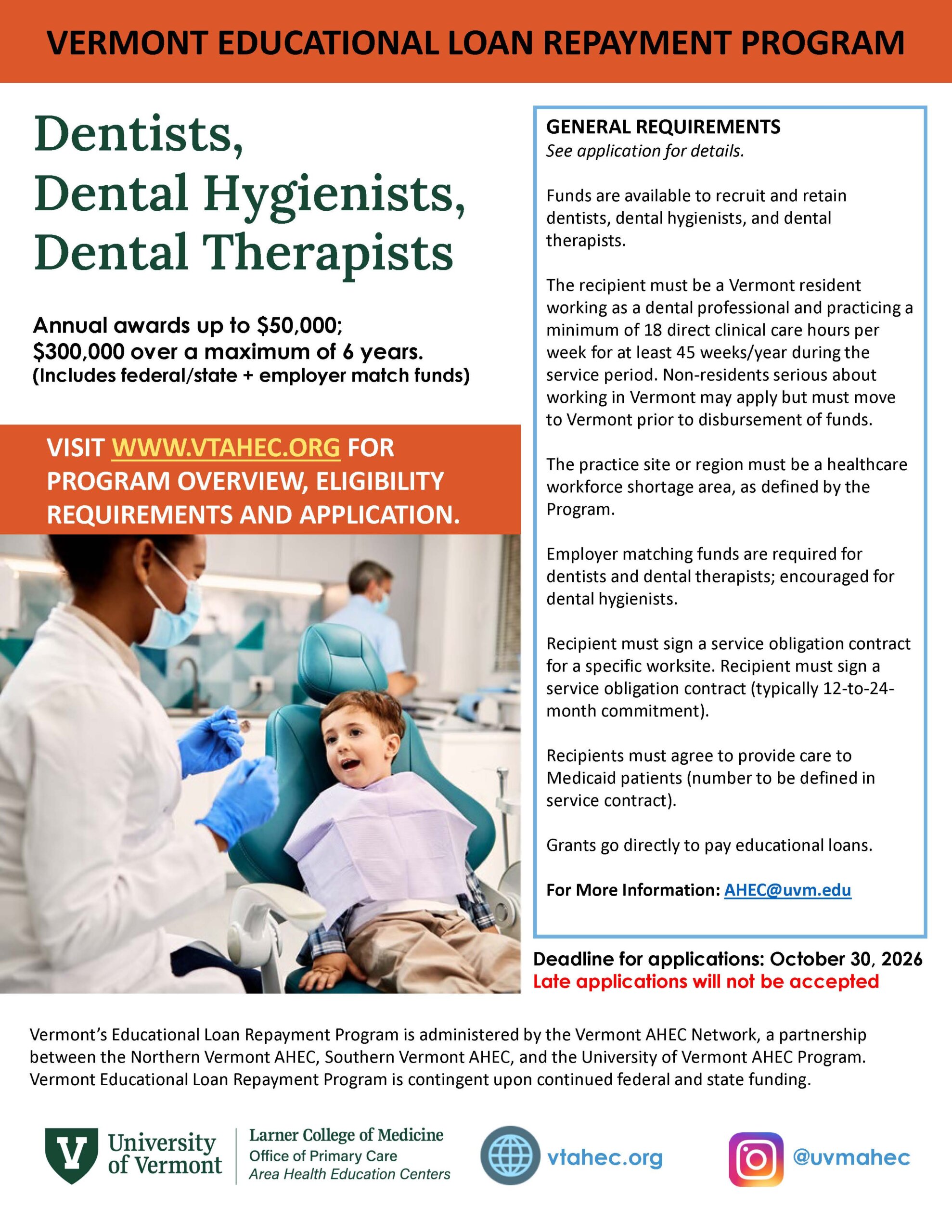
The Vermont Educational Loan Repayment Program is contingent upon continued federal and state funding.
2027 Program Overview and Participant Eligibility
The purpose of this educational loan repayment program is to increase access to health and dental care in underserved communities and to address the health professional shortages that cause disparities in access to health care in Vermont.
Description
The program is funded by the federal State Loan Repayment Program (SLRP), state, and local funds. AHEC, on behalf of the state, makes loan repayment awards in exchange for contractual service commitments by eligible health care professionals. Recipients must have outstanding educational debt acquired while pursuing an undergraduate or graduate degree from an accredited college or university that exceeds the loan repayment award amount. Maximum total annual funds are up to ,000, including federal, state, and match funds.
The VT ELR Program serves three types of dental applicants:
- Retention: Dentists, dental therapists, and dental hygienists currently working at eligible Vermont worksites. One- or two-year awards are available. An employer match is required for dentists and dental therapists, and for registered dental hygienist two-year awards.
- Recruitment: One-year awards for dentists only, initiated by the worksite to recruit workforce to an available eligible role. An employer match is required. Due to program grant timelines, apply for a recruitment award only when an identified candidate will begin work no later than October 1, 2027.
- Job-Seeker: One-year awards for UVMMC dental residents in their final year of training who are seeking employment in Vermont. An employer match is not required.
Award Amount and Employer Match
Dentists and dental therapists: Current educational loan debt must exceed ,000. Awards may range from ,000 to ,000 in state and federal funds per year for full-time practitioners and from ,000 to ,500 per year for half-time practitioners. Awards go directly to educational loans. Employer match is required: a minimum of ,000 per year for full-time practitioners and ,000 per year for part-time practitioners.
Registered dental hygienists: Current educational loan debt must exceed ,000. Awards may range from ,000 to ,000 in state funds per year for full-time practitioners and from ,500 to ,000 per year for half-time practitioners. Awards go directly to educational loans. An employer match is required for a two-year award and encouraged for a one-year award: a minimum of ,000 per year for full-time practitioners and ,500 per year for part-time practitioners.
Once the Employer Application, Section E, is submitted to AHEC, the employer match pledge cannot be added or rescinded later.
Tax Liability and Award Prioritization
The federal Affordable Care Act, passed March 23, 2010, treats debt repayment under the AHEC-administered Vermont Educational Loan Repayment Program for Healthcare Professionals as exempt from income tax purposes.
Program objectives and selection criteria are established annually by the Vermont Department of Health in consultation with AHEC, in accordance with Vermont law and the federal Public Health Service Act. Priorities are designed to respond to the state’s most pressing workforce needs, with special consideration for Vermont’s most rural, underserved, and undersupplied areas, including federally designated Health Professional Shortage Areas (HPSAs). Other factors may include local recruitment and retention goals, educational loan debt level, hours worked each week, service as a preceptor to health professions students, and other award parameters.
Applicants are encouraged to review Vermont dental workforce data before applying. Relevant resources include the Vermont Relicensure Survey and Health Professional Shortage Area designations and scores.
Citizenship, Residence, and Eligible Practitioners
Recipients of federal SLRP funds must be United States citizens or nationals, including naturalized citizens. United States citizenship is not required for state funds.
By legislative statute, a recipient must be a Vermont resident at the time of payment, be legally authorized to work in the United States, and serve in Vermont. Eligible practitioners are Vermont-licensed dentists, dental hygienists, and dental therapists employed in Vermont.
UVM Health Network note: The UVM Health Network Medical Group offers loan repayment assistance to physicians and dentists hired on or after May 1, 2019. Eligibility for the UVMHN Physician Loan Assistance Program is up to four years. AHEC loan repayment and UVMHN loan assistance eligibility are not concurrent. Contact the UVMHN Medical Group for details.
Eligible Practitioner Hours
Half-time, 20 to 39 hours per week: At least 18 hours per week must be direct clinical care. This may include up to four hours per week in teaching activities or approved alternative settings. Up to two hours per week of administrative duties may contribute to the 20-hour weekly minimum.
Full-time, 40 hours per week: At least 36 hours per week must be direct clinical care. This may include up to eight hours per week in teaching activities or approved alternative settings. Up to four hours per week of administrative duties may contribute to the 40-hour weekly minimum.
Clinical service must last at least 45 weeks each year. Participants taking more than seven weeks of leave in a service year, for any reason including workers’ compensation, do not meet the 45-week minimum. Award decisions factor average clinical hours each week and vary by full-time versus half-time status.
Ineligible Practitioners
Ineligible applicants include those not listed as eligible practitioners; locums; per diem, contract, traveling, or temporary practitioners; and those holding J-1 visa waivers. Also ineligible are practitioners who fail to meet or show growth toward Medicaid targets in past loan-repayment contracts; practitioners with a current contractual service obligation to the federal government, state, employer, or another entity unless that obligation will be fully satisfied before this program contract is signed; individuals with loans through the Department of Health and Human Services or HRSA; practitioners actively training in residency or fellowship programs who are not in their final training year; recipients with more than one incentive-program contractual service obligation during the same period; and those with a breach of contract for a previous service obligation.
Certain employment-contract provisions can create a service obligation, such as an employer bonus conditioned on working at a facility for a stated period or repaying the bonus.
Educational Debt and Public Service Loan Forgiveness
Educational debt is verified and loans must be in good standing. Current loan balances must exceed the total educational loan repayment award. Qualifying debt is educational debt obtained through a United States student loan program. It cannot include loans consolidated with another person, loans borrowed for another person’s education, or mortgage, car, credit-card, personal, family, business, or other non-educational debt.
The program is a partnership among the recipient, the State of Vermont, the United States Department of Health and Human Services, and communities, practices, employers, and foundations to improve access to care through contractual service obligations in exchange for educational-debt reduction.
Because recent Public Service Loan Forgiveness (PSLF) changes and individual-account audits may result in retroactive forgiveness of federal Direct Loans, a borrower may receive an overpayment reimbursement. Per federal guidance, reimbursements from an awardee’s lender that result from excess payments made through the Vermont Educational Loan Repayment Program should be returned to the educational loan program that originated the payment. Notify AHEC immediately if you received AHEC-administered funds in 2025 or 2026 and are eligible for a PSLF overpayment reimbursement.
Those employed by nonprofit organizations and eligible for PSLF are strongly encouraged to enroll. Learn more at StudentAid.gov. If PSLF pays off loans before the service-obligation end date, it does not alter the service period. If program funds have been disbursed, the service contract remains active until fulfilled. To maximize limited program funds, do not apply if you are approaching educational loan payoff through PSLF.
Finances and Eligible Work Sites
An applicant must not have federal judgment liens, defaulted on federal payment obligations including student loans, federal or non-federal debt written off as uncollectible, or a waiver of a federal payment obligation.
Eligible worksites are dental practices in Vermont. Federal SLRP funds focus on practitioners employed at federally qualified health centers in federally designated HPSAs. Providers must work in an HPSA corresponding to their training or discipline; for example, a dentist must serve in a dental-health HPSA. State funds may be used more broadly than SLRP funds.
Eligible worksites accept patients covered by Medicare, Medicaid, Vermont’s Children’s Health Insurance Program (Dr. Dynasaur), or other state-funded health-care benefit programs. A minimum target number of unique Medicaid patients served during the contract period is determined at award and specified in the service contract.
Practices and practitioners that charge patient membership or enrollment fees, including health fees, direct-to-patient fees, or concierge fees, are not eligible. Such fees can create barriers for Medicaid, rural, and underserved patient populations.
Service Obligation
Recruitment and job-seeker award recipients have a one-year, 12-month service commitment. Retention award recipients may have up to a two-year, 24-month service commitment. A two-year commitment requires two continuous years of service; disbursement may be made up front for two years or at the start of each service year. Employment is verified before funds are disbursed.
The service period is defined in the award contract and cannot begin before a fully executed contract or work start date, whichever is later, without prior approval. There is no credit for practice before the contract is executed, while in school or training, or during a leave of absence. Recipients taking leave for any reason who do not meet the 45-week requirement must extend the service-contract end date.
An award is for one specific worksite and timeframe. Awards and contracts are not transferable. Worksite changes in Vermont are rarely authorized except for internal transfers within the same organization, and a transfer exception must be requested before changing worksites. Participants who resign voluntarily or are terminated for cause may be placed in breach of contract. Applicants who need flexibility to change jobs at any time should consider carefully whether this program is a fit.
Reapplication, Cancellation, and Breach
Reapplication is required to extend awards beyond the designated service-obligation period. A participant receiving a two-year award does not reapply for the second year. An individual may receive loan-repayment funds for a maximum of six years, up to ,000 in total.
An award offer may be cancelled without penalty before a contract is fully executed or before the first disbursement. The award and service contract are cancelled in full upon a participant’s death. Service and repayment obligations may be waived or postponed for incapacity from serious illness, at the program’s discretion and with medical documentation. Temporary leave of up to one year may be granted and the service period extended for temporary impossibility or extreme hardship.
A participant may request contract termination for extenuating, unforeseen, and documented circumstances in writing and with repayment of all loan-repayment funds disbursed under that contract. Termination is not effective unless the program approves the request and all loan-repayment funds are repaid within 30 days. Awards depend on funding from the State of Vermont and/or the United States Department of Health and Human Services; withdrawal or reduction of funding before disbursement may terminate or revise the agreement. Employment changes after a contract is executed and after the first disbursement may result in breach of the service obligation.
A breach may occur after a service contract is signed and a disbursement is made. If service is not completed, the participant incurs a debt to the State in an amount not less than damages owed under the NHSC Loan Repayment default provision. Damages include a financial penalty and interest. The participant must repay amounts required by the service contract, plus interest and collection costs, at the maximum legal prevailing rate determined by the Treasurer of the United States from the breach date. Applicants are ineligible if they have ever breached or received a waiver of a prior service obligation to a federal, state, local-government, or other entity, even if they subsequently satisfied the repayment obligation. Breaches are reported to funders and may reduce program funding.
Apply and Learn More
For the program overview, eligibility requirements, and application, visit www.vtahec.org. For more information, email AHEC@uvm.edu. Applications are due October 30, 2026; late applications will not be accepted.